Bowling's digital daily newspaper delivering news, analysis and opinion.
PBA Tour champion A.J. Chapman edges college star Kendric Siders in title match to win 2026 GIBA 11thFrame.com Open
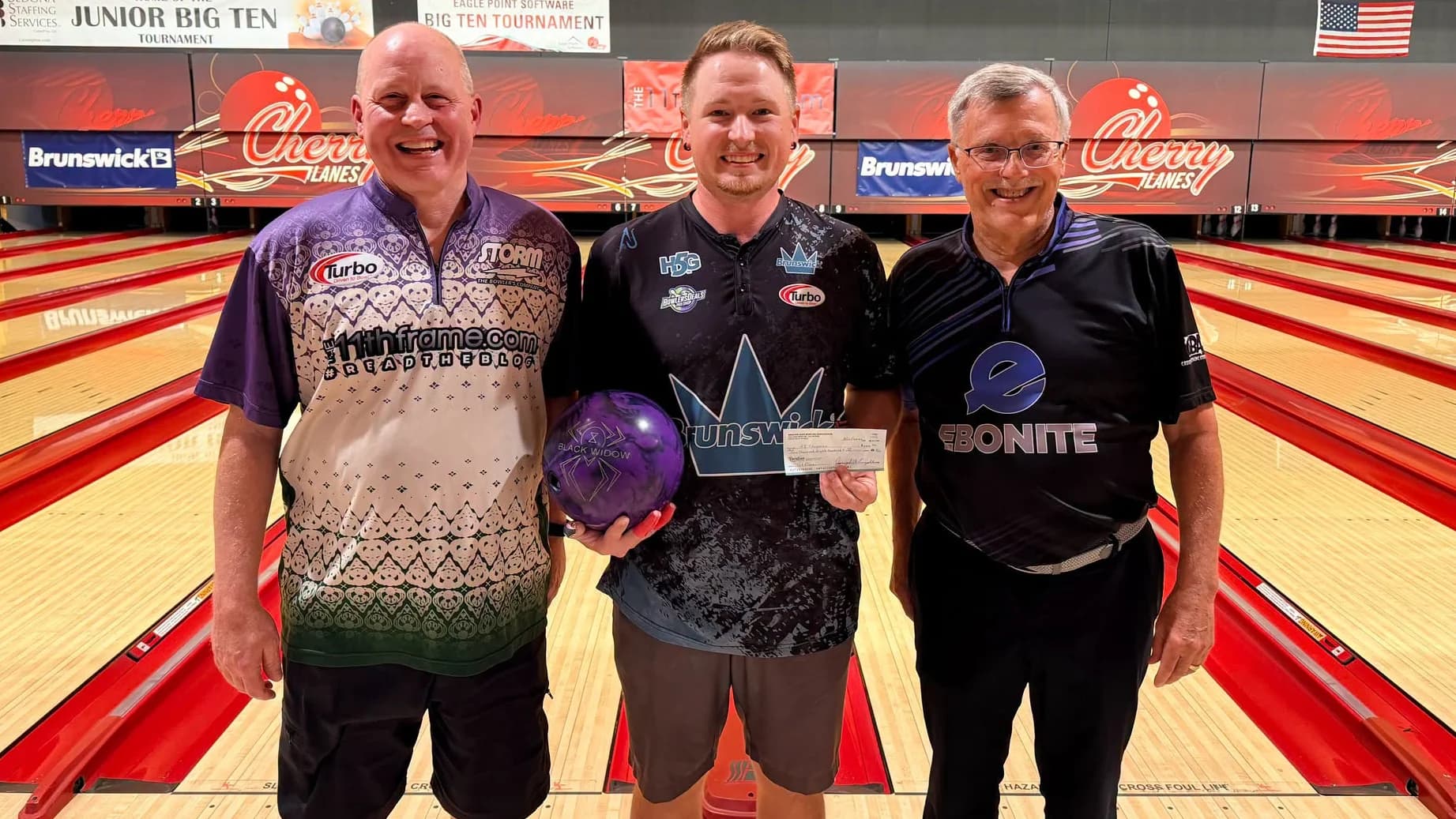
In a tight title match in which both bowlers came through in the clutch, PBA Tour champion A.J. Chapman edged college star Kendric Siders 237-233 to win the 2026 GIBA 11thFrame.com Open over the weekend.
Chapman, who now lives in the Dallas area, grew up in Manchester, Iowa, which is about 45 minutes west of Dubuque, so the win had special meaning for him.
“It's amazing to get a win in Iowa again,” Chapman told InsideBowling.com’s Mike Flanagan moments after his win. “It feels good. I think this might be my actual first men's Greater Iowa (Bowling Association) win. Got second at the Fall Classic when Tom (Hess) bowled 278 against me in the title match. Mom and dad were here and that was great. It was a big part of me getting it done. And my brother Ben was here yesterday watching the whole time too, so that was great.”
All of the competition Saturday and Sunday from Cherry Lanes inside the Diamond Jo Casino in Dubuque, Iowa was webcast by Mike Flanagan’s InsideBowling.com at its YouTube channel. Here is the archive of the stepladder.
The 156 players bowled six games with the top 48 advancing to Sunday’s competition and four additional players cashing.
Chapman, who won the 2026 PBA Roth/Holman Doubles with Zach Wilkins in April for his first PBA Tour title, led qualifying with 1,512, as I detailed in this story.
Sunday’s innovative format that comes from the fertile mind of Flanagan features 12 games of bowling starting at 9 a.m. with bonus pins based on score from highest to lowest. For example, if 48 advance to Sunday in each game the highest scorer will get 48 bonus pins, the second-highest scorer 47 pins, so on down to 1 bonus pin for the lowest score each game. Whatever number of finalists there are, that number of bonus pins will go to the high scorer down to 1 pin for the lowest score each game.
Yes, it’s not head-to-head; instead, it’s all-against-one. The idea is to reward the consistently solid bowler and not the one who may bowl the right people at the right time. And everyone who makes the cut gets to bowl all of Sunday's games.
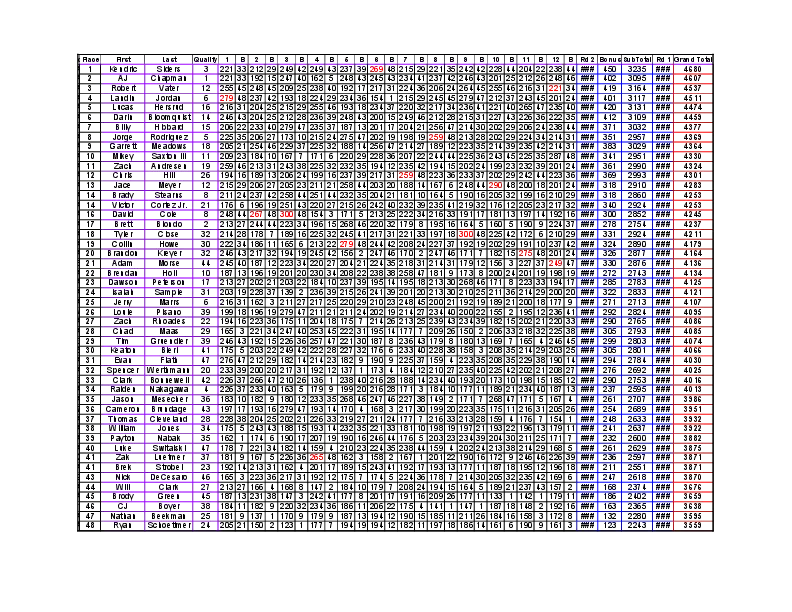
Results were posted here. For Sunday, this Google doc provides game-by-game scoring and standings.
After 18 games, the top five advanced to the stepladder finals.
With a game to go, Siders was leading with 4,398, followed by Chapman at 4,313, Robert Vater 4,282, Landin Jordan 4,286, Darin Bloomquist 4,202, and Lucas Hersrud 4,199.
Chapman’s 248 finish and 46 bonus pins in the final game wasn’t quite enough to catch Siders, who finished with 238-44, but it did keep Chapman in second.
Vater, who won Friday’s sweeper, moved into third with 221-34, while Jordan fell a spot to fourth with 201-24.
Hersrud edged out Bloomquist for the fifth spot by 15 pins with a 235-40 finish to Bloomquist’s 222-35.
The format has enabled players to come from near the bottom of the top 48 to make the stepladder, but this year all five finalists started Sunday in the top 16, and no one from outside the top 20 made the top 11.
Chapman at 32 was at least 10 years older than the rest of the stepladder finalists, with Mount Mercy graduate Vater the oldest at 22. The other three are college players, with Siders and Hersrud part of reigning ITC champion St. Ambrose and Jordan at Savannah College of Art and Design.
USBC lane pattern designer Nick Hoagland gave us a new lane pattern for this year’s tournament with the goal of bringing scores down a bit, and it did.
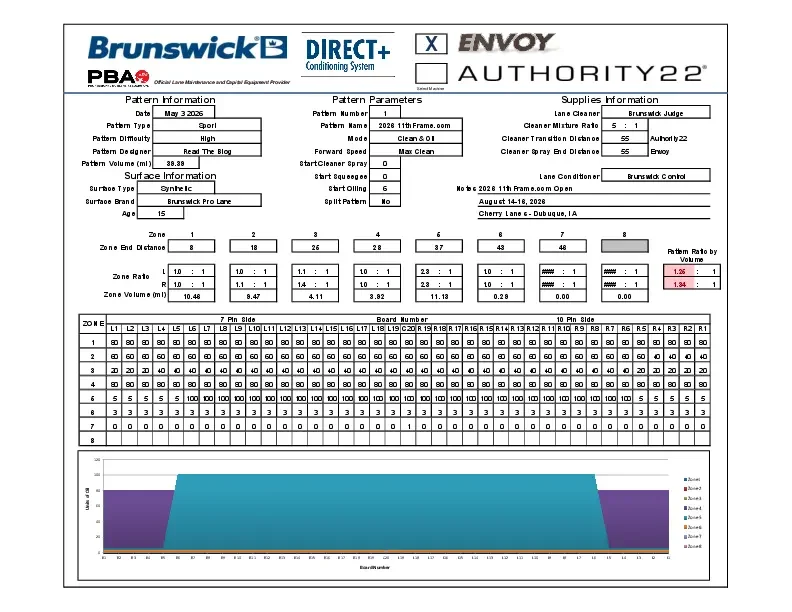
The pattern was similar to lane pattern 4 from the 2026 U.S. Open and the 2015 U.S. Open. It was 46 feet and featured a high volume of 39.39 mL of Brunswick Control oil with main ratios of 1.25-1 on the left side and 1.34-1 on the right side. Almost all of the oil is applied in the first 37 feet. The PDF of the pattern is attached to this story.
“39 mLs - that's crazy,” Chapman told Flanagan. “I don't think I've ever bowled on that much volume before. So being that flat, that long, and with that much volume, it feels pretty good to come out on top.”
Players generally used strong balls with a lot of surface and it often took some play for it to open up on the right side, which was true in the stepladder.
Hersrud took the early lead when Jordan left a pocket 7-10 in the third frame, but Jordan took over with a 3-bagger starting in the fifth, while Hersrud couldn’t’ string strikes and failed to convert the 3-9 in the sixth.
But when Jordan could only finish with spares of the 10-pin and the 2-4-8 twice he opened the door for Hersrud to close with three strikes and a 9-count for a 216-201 win. Hersrud’s clinching strike to start the 10th was beautiful flush shot.
Hersrud then routed Vater 279-182, as Vater never doubled and opened in the sixth on a 4-10 split. Hersrud struck, left a flat 10 he spared, then fired a 9-bagger that included a Brooklyn for his second strike.
In the semifinal, Hersrud started with a spare and then a 3-6-9-10 he couldn’t convert, while Chapman started with a double and 2-10 split for an opening.
Chapman rebounded with a 6-bagger, and Hersrud with a strike, a 4-pin conversion and a 4-bagger, but when Hersrud left another 4-pin in the ninth, Chapman was able to coast to a 243-224 win with a 10th frame spare.
Chapman started the title match with three flush strikes and never was behind, but Siders rallied to make him earn it in the 10th.
Sider started with a solid 10 he spared and a double, then made the 2-4-8, doubled again, and made the 3-10 and the 10-pin before rolling three strikes and leaving a 10 on his fill ball for 233.
After his opening 3-bagger, Chapman left and spared a pair of 10-pins, then fired another 3-bagger before leaving a solid 9-pin for a spare on a high hard one that held in the oil.
Siders’ strong finish left Chapman needing 9-spare-8 or better to win and he rolled a mixer strike and added a 3-6-10 and spare for 237.
Chapman had nothing but praise for the young talent of the stepladder, especially Siders, noting “his touch at the bottom,” which I 100% agree with.
“I got to watch today firsthand,” Chapman told Flanagan of Siders. “I've seen him bowl in some videos. I watched him bowl with St. Ambrose in the ITCs last year. Today was the first time I got to watch him throw it. I was chasing him down the whole time. I was thoroughly impressed. His touch is incredible. I think he might be a force to reckon with in the future.”
Chapman said he started with a Hammer BLACK WIDOW 3.0 DYNASTY and switched to an Ebonite THE ONE OVATION for the final seven games of the semifinals before switching back to the DYNASTY for the stepladder. He thanked doubles partner Zach Wilkins for layout tweaks on the balls.
But he said the biggest key in his game has been switching back to no finger grips after using grips for the past four years.
“That's really helped me with my touch at the bottom, and I can feel a bigger difference of when I throw it bad now, and I don't make adjustments off shots I think I throw good instead of they're just bad,” Chapman told Flanagan. “So I've had better success with my touch and release, making sure my fit is right. That's a big thing.
“And it's all mental, honestly too. … This might be the best that I've mentally been through a tournament in a long time. I took a little break after the season. I took a month off from competition, basically, to get my mind back in a better spot. And my game has felt really solid right now, so I think if I can add a solid mental game on top of a good physical game, good things happen. This is the first test, I guess, that's shown it's on the right path.”
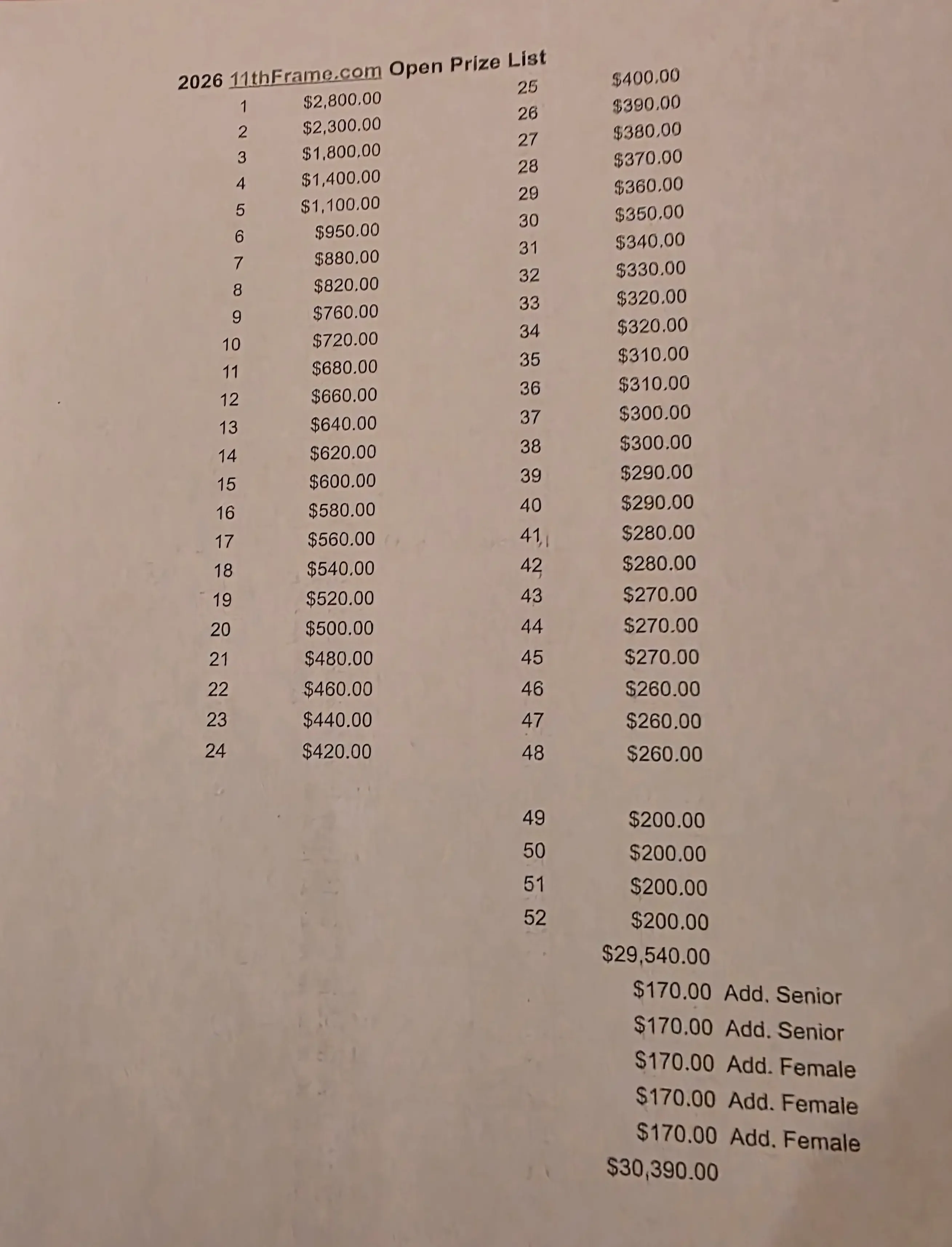
With the usual full field of 156 entries, first through fifth was $2,800, $2,300, $1,800, $1,400 and $1,100, while Chapman also earned $630 in the Bet You Win pot.
The full prize list is attached to this story as a PDF.
Here is my preview of the 11thFrame.com Open that includes details on what changed this year.
GIBA administrator Joe Engelkes said in an email to GIBA players on July 2 that long-time sponsor the Dubuque Regional Sports Commission changed its rules so it now allows events to request funding only every third year. That means GIBA wasn’t even able to request funding for the 2026 11thFrame.com Open and also won’t be able to in 2027.
Fortunately, Joe was able to come up with a plan that maintains the prize fund and it includes an entry fee hike from $160 to $170 (matching the Ebonite Classics), and me hiking my sponsorship from $400 to $500 and moving it from slot cards for non-cashers to the prize fund, as well as some additional sponsorship and administrative adjustments.
Engelkes said there is more than $3,000 in added money from GIBA sponsor Ebonite and returning tournament sponsors Diamond Jo Casino, Cherry Lanes, Brandon Steen/The Steen Team, IAMBowling, Kwik Star/Kwik Trip, and 11thFrame.com.
I will add Engelkes’ report on the tournament after he sends it out.
Many thanks as always to GIBA's Joe and Rosie Engelkes and their daughter Jennifer Wittenburg for their great work running the tournament, Bob Hochrein and the awesome staff at Cherry Lanes, and Mike Flanagan of InsideBowling fior his tireless work on the webcast. They all do far more than me to make this tournament what it is.
Look for the 2027 11thFrame.com Open to be on the same weekend, which is Aug. 13-15.
Matt McNiel won in 2012, Matt Gasn in 2014, McNiel again in 2015, Jay Watts in 2016, Adam Morse in 2017, Andy Mills in 2018, Nate Stubler in 2019, Jerry Marrs in 2020, Stubler again in 2021, Nick Pate in 2022, Dakota Solonka in 2023, Crowe in 2024. and David Cole II in 2025. (No tournament was held in 2013.)